2026-27 Topps Flagship Basketball Odds Deep Dive: Hobby vs Jumbo vs Value vs Mega
Official 2026-27 Topps Flagship Basketball odds converted to hits per box, chase rates, Hobby vs Jumbo break-even math, and what the model cannot tell you.
- Published
- Read
- 13 min
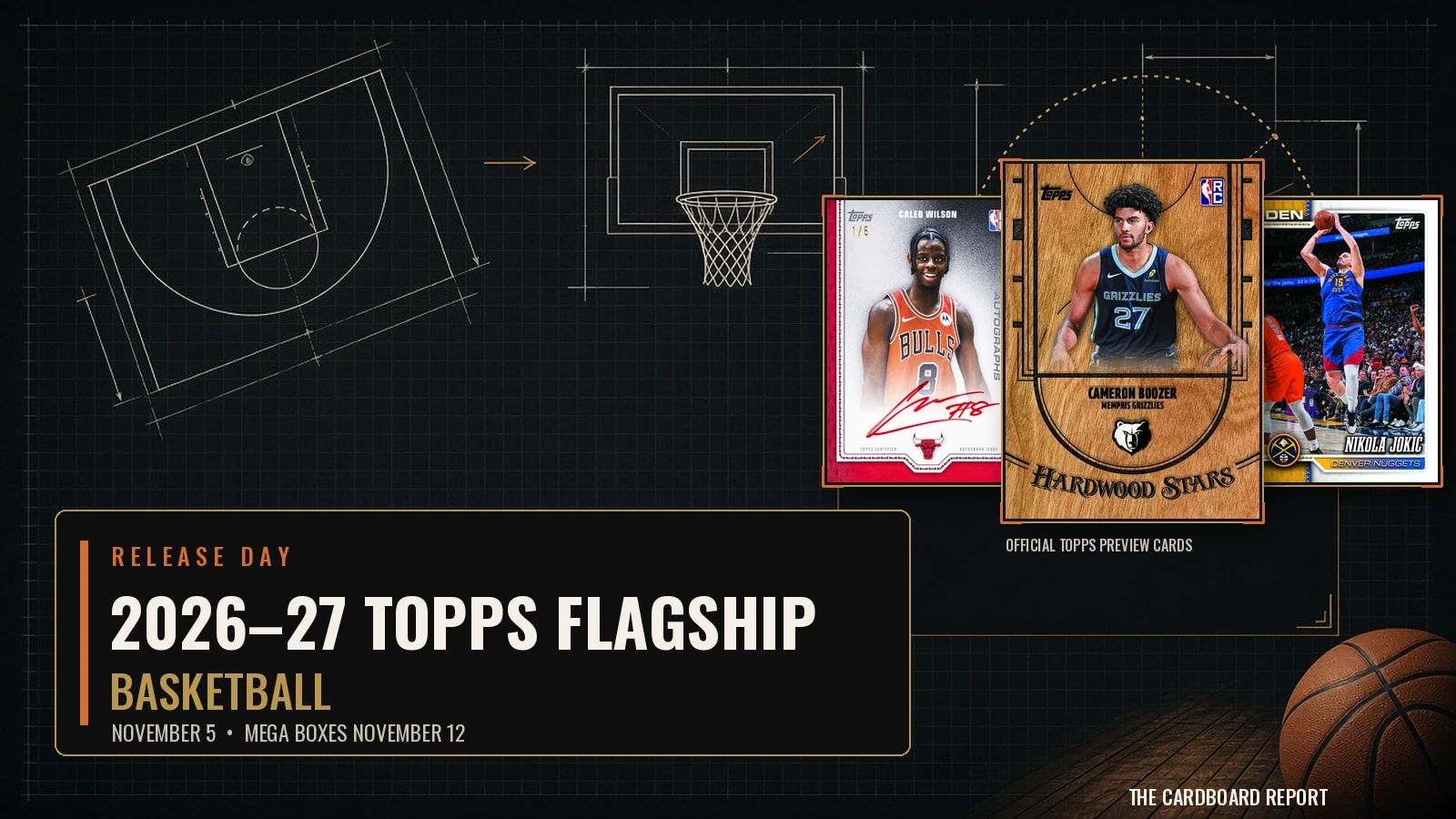
Card images: official Topps preview cards via Topps Ripped, shown for editorial identification. They are not store inventory. Background: original CardBoard Report artwork.
2026-27 Topps Flagship Basketball came out Nov. 5. Topps' release page says "Available now, Mega boxes available November 12." Topps also published a full odds sheet (dated Nov. 4, 2026) and a Wave 2 education sheet. We ran 457 extracted odds rows through a calculation model to answer the questions people actually ask: How many hits are in a box? Which box is best for which chase? Is Jumbo worth the extra money? And what can't the odds tell you?
If you want the 300-card checklist and rookie list, start with our checklist and box guide. This piece is about the numbers.
Official Topps sources rechecked Nov. 5, 2026, about 5:00 p.m. America/Chicago (Central Time). All math comes from Topps' published odds. It's a model, not a promise about any box. Listed Topps.com prices are what we saw at that check; they are not a stock claim.
Part 1: The basics
| Hobby | Jumbo | Value | Mega | |
|---|---|---|---|---|
| Packs × cards | 20 × 12 | 10 × 28 | 6 × 12 | 12 × 15 |
| Cards per box | 240 | 280 | 72 | 180 |
| Stated guarantee | 1 auto or relic | 1 auto and 1 relic | none | none |
| Topps.com price seen Nov. 5 ~5 p.m. CT | $179.99 | not shown (listing sold out) | $29.99 | not confirmed on U.S. Topps.com |
| Release | Nov. 5 | Nov. 5 | Nov. 5 | Nov. 12 |
Configurations and guarantees come from the Topps education sheet and match the matching Topps.com product listings (Hobby uses or; Jumbo uses and). Prices above are only the U.S. Topps.com figures we could confirm at the check time. The Hobby case (12 boxes) showed sold out. The Jumbo box listing showed sold out without a displayed U.S. price. Mega is dated November 12 on Topps; we did not confirm a U.S. Mega price this check. We don't use resale or third-party prices.
Part 2: Why we treat the odds as per pack (and how we checked)
The odds sheet prints ratios like 1:1,306 under format names but never says "per pack." Topps odds are conventionally per pack, but we didn't want to just assume it, so we tested it against Topps' own box guarantees.
If you add up every autograph and relic row in each column, you get the expected number of hits per pack. Multiply by packs per box:
| Format | Expected autos per box | Expected relics per box | Total | What Topps guarantees |
|---|---|---|---|---|
| Hobby | 0.50 | 0.60 | 1.10 | 1 auto or relic |
| Jumbo | 1.03 | 1.20 | 2.23 | 1 auto and 1 relic |
| Value | 0.050 | 0.048 | 0.098 (about 1 per 10 boxes) | none |
| Mega | 0.10 | 0.15 | 0.25 (about 1 per 4 boxes) | none |
Read per pack, the results are broadly consistent with the stated minimum guarantees: about one hit per Hobby box and about one auto plus one relic per Jumbo box. If the numbers were per box, Hobby would come out around 20 times too low. That's strong evidence the ratios are per pack, and every number below uses that basis.
The first big takeaway: the model estimates about 0.5 autographs per Hobby box and 1.03 autographs per Jumbo box. Expected autograph counts are not the probability of getting an autograph: packing guarantees, extra-hit boxes and collation can change that probability. Only the printed box guarantee is assured. For Hobby, that guarantee is one autograph or relic, not one autograph.
Part 3: The heat map, per box and per 100 boxes
"1 in 1,306 packs" is hard to picture, so we converted each rate two ways:
- Per 100 boxes: how many you'd expect across 100 boxes of that format.
- Boxes per one: how many boxes it takes, on average, to see one.
Where a chase has several versions (base plus parallels), we added the separately listed rows together because they are separate cards. Expected counts add even when pack outcomes are not independent; "at least one" probabilities in Part 4 do not. A "–" means Topps doesn't list it for that format.
| Chase | Hobby per 100 boxes | Jumbo per 100 | Value per 100 | Mega per 100 | Hobby boxes per one | Jumbo boxes per one |
|---|---|---|---|---|---|---|
| All Kings (incl. Gold 1/1) | 1.53 | 2.31 | 0.02 | 0.04 | 65 | 43 |
| Hardwood Stars | 3.19 | 4.81 | 0.04 | 0.09 | 31 | 21 |
| Bounce | 0.64 | 0.96 | 0.01 | 0.02 | 157 | 104 |
| Class of 26 (incl. Red, FoilFractor) | 1.29 | 1.94 | 0.02 | 0.04 | 78 | 52 |
| Comic Court | 0.81 | 3.38 | – | – | 124 | 30 |
| Quest for the Crown | 0.81 | 3.38 | – | – | 124 | 30 |
| Golden Mirror Image Var. (I+II+III) | 6.58 | – | 0.47 | 0.73 | 15 | – |
| Player Number Variation | 1.11 | – | – | – | 90 | – |
| Clear Variation | 0.08 | 0.16 | 0.01 | 0.03 | 1,229 | 628 |
| Base Wood /25 | 0.61 | 1.19 | 0.11 | 0.22 | 164 | 84 |
| Base Black /75 | 1.83 | 3.58 | 0.32 | 0.67 | 55 | 28 |
| Base Gold /2026 | 64.5 | 100 | 9.5 | 23.5 | 1.6 | 1.0 |
| 1981-82 Rookie Autographs (all versions) | 5.14 | 10.58 | 0.51 | 1.03 | 19.5 | 9.5 |
| Flagship Real One Rookie Autograph (all) | 1.72 | 3.55 | 0.17 | 0.34 | 58 | 28 |
| Rookie Photo Shoot Autographs (base, Red, Platinum) | 0.77 | 1.60 | 0.08 | 0.15 | 130 | 63 |
| Certified Cold (retail) | – | – | 0.12 | 0.25 | – | – |
A few things jump out:
- Most of these aren't "case hits" in Hobby. A 12-box Hobby case averages about 0.18 All Kings (roughly one per 5–6 cases), 0.38 Hardwood Stars (about one per 2.6 cases) and 0.08 Bounce (about one per 13 cases). The education sheet lists All Kings, Quest for the Crown, Bounce and Class of 26 among its insert spotlight cards, but don't assume one per case. By the odds, they're rarer than that.
- Jumbo isn't better at everything. Per box, it beats Hobby on almost every shared chase, but it has no Golden Mirror Image Variations and no Player Number Variations at all.
- Comic Court and Quest for the Crown are where Jumbo pulls furthest ahead. Their per-pack odds are about 8.4 times better in Jumbo (1:296 vs. 1:2,475). Even with half the packs per box, that's about 4.2 times more per box.
- Retail is a different product for chases. At these odds, chasing All Kings in Value boxes means about 4,900 boxes per card. Retail's real chases are its own cards: Certified Cold, Soundcheck, Season Tip Off (Value) and the Holo Foil parallels.
Part 4: "What are my chances of at least one?" (a theoretical model)
Expected counts aren't the same as the chance of hitting. Here's a rough theoretical model. It treats pack-level hit events as independent with a constant rate and uses a standard approximation: chance of at least one ≈ 1 − e^(−expected count) (a Poisson / rare-event approximation of sampling without replacement when hits are sparse).
| Chase | One Hobby box | One 12-box Hobby case | One Jumbo box |
|---|---|---|---|
| All Kings (any) | 1.5% | 17% | 2.3% |
| Hardwood Stars | 3.1% | 32% | 4.7% |
| Golden Mirror (any of I–III) | 6.4% | 55% | 0% (not in Jumbo) |
| 1981-82 Rookie Autograph (any version) | 5.0% | 46% | 10.0% |
| Flagship Real One Rookie Autograph (any) | 1.7% | 19% | 3.5% |
| Rookie Photo Shoot Autograph (any single) | 0.8% | 9% | 1.6% |
Important caveats. These are approximate, not exact. Real packs are not independent coin flips: Topps sorts cards into packs, boxes and cases (collation), and stated packing guarantees change the box-level distribution. The Poisson formula approximates a without-replacement pull only when hits are rare relative to the pool; it can drift when expected counts get large. These numbers describe a long-run rate model across the print run. They aren't a forecast for your box, and none of them is a guarantee. We didn't calculate odds for a specific player: we haven't checked that every player is equally likely within a set, and we won't assume it.
Part 5: Price-based comparison (only where Topps' price is confirmed)
We only have confirmed U.S. Topps.com prices for Hobby ($179.99) and Value ($29.99) from the check above, so the dollar comparisons use those two boxes only. These are cost per expected card, not the value of what you pull.
| Metric (Topps.com price ÷ expected count per box) | Hobby @ $179.99 | Value @ $29.99 |
|---|---|---|
| Per card | $0.75 | $0.42 |
| Per autograph or relic | $164 | $307 |
| Per autograph | $360 | $600 |
| Per Base Gold /2026 | $279 | $315 |
We left rare cards out of this table on purpose. A Base Black /75, for example, works out to about $9,800 of Hobby boxes per expected card. That number tells you the card is rare, not what it costs to buy one, which is why cost-per-hit math stops being useful for rare cards. At Topps' listed prices, Value is cheaper per card, but Hobby is clearly cheaper per hit and per autograph. Value also locks you out of the Hobby-only Rainbow parallels, Victory parallels and Player Number Variations.
Jumbo vs. Hobby break-even
Since we don't have a confirmed U.S. Jumbo price, here's the multiple of the Hobby price at which Jumbo becomes equal on a cost-per-expected-card basis:
| Chase | Jumbo per box ÷ Hobby per box | Jumbo break-even at Hobby's $179.99 |
|---|---|---|
| All Kings / Hardwood Stars / Bounce | about 1.5× | about $270 |
| Comic Court / Quest for the Crown | about 4.2× | about $750 |
| Autographs (FRO Rookie, RPS, 1981-82 Rookie) | about 2.07× | about $372 |
| All autographs combined | 1.03 ÷ 0.50 ≈ 2.07× | about $372 |
| Golden Mirror / Player Number Variation | Jumbo can't produce them | — |
Here's how to use it. If you can buy a Jumbo for less than about 2× the Hobby price you'd pay, it's the cheaper way to chase autographs on paper. For All Kings and Hardwood Stars, it needs to be under about 1.5×. This is a model built on Topps' odds. It doesn't tell you what the cards are worth.
Part 6: How checklist size changes what "rare" means
Odds tell you how hard it is to pull a card from a family, not a specific card. If a family's row covers 20 players, a single player's card is far harder to pull than the family odds suggest, even before you consider whether every player is seeded equally. We didn't verify card counts and seeding for every family, so we don't publish per-player odds.
Serial number and pull difficulty are also different things. A Base Gold /2026 is technically "numbered," but Hobby averages about 0.65 per box. The Base Wood /25 family averages about 0.6 cards per 100 Hobby boxes; that does not establish that all 300 base subjects have a Wood version. Serial numbers tell you how many copies of one card exist. Odds tell you how often you'll pull any card from that family. You need both.
Format-exclusive parallels split the rainbow too:
- Hobby-only: Victory (1:9 packs)
- Hobby and Jumbo only: the Aqua-to-FoilFractor Rainbow run
- Jumbo-only: Sandglitter (Red Sandglitter /5 at 1:604 Jumbo packs)
- Value-only: Season Tip Off
- Retail: the Holo Foil run, including Black Holo Foil /10
A "Red /5" from one format isn't the same card as a "Red /5" from another, so match the exact parallel name when buying singles.
Topps' education sheet gives these print runs: base Gold /2026, Black /75, Gold Rainbow /50, Wood /25, Black Holo Foil /10, Red Sandglitter /5, First Card 1/1. Insert and autograph parallels run Green /99, Yellow /75, Gold /50, Orange /25, Black /10, Red /5, FoilFractor 1/1.
Part 7: What about print runs?
Some analysts estimate total production from odds sheets. We tested it here. We combined the Jumbo-only Red Sandglitter /5 with the Hobby and Jumbo Gold Rainbow /50, then checked the result against the 1/1 FoilFractor. The numbers didn't line up exactly: the check came out about 4% off (roughly 311 implied FoilFractors vs. 300 expected under full parallel coverage). That method also assumes every one of the 300 base cards exists in every parallel, and Topps says that isn't guaranteed. So we aren't publishing box or print-run estimates for this set. Our method and the raw result are in our audit notes if you want to check our work.
Part 8: What the odds don't tell you
- Value or ROI. The odds say nothing about what a pulled card will sell for. Rookie prices in release week are especially unstable.
- Guarantees beyond the box label. The only guarantees are the ones Topps prints: 1 auto or relic per Hobby box, and 1 auto and 1 relic per Jumbo box.
- Your box. Topps' own disclaimer says "actual contents and odds may vary," and that a subject being on the checklist doesn't guarantee it appears in every parallel or variation.
- Formats we skipped. The sheet also has Hanger, Fat Pack, Fanatics Value, Black Friday Value, All-Star Game, China-exclusive, Costco and Sam's Club columns. Many are blank, and we haven't modeled them here.
Part 9: Our take
- Want autographs and the big inserts? If you can find Jumbo for less than about twice the Hobby price, it's the efficient choice on paper. It has about double the autograph rate, about 1.5× the All Kings and Hardwood Stars rate and over 4× the Comic Court and Quest for the Crown rate. Just know it can't produce Golden Mirror or Player Number Variations.
- Want Golden Mirror, Player Number Variations or Victory? Only Hobby has all of them. At the $179.99 Topps.com price we saw, it's the steady choice, with a stated guarantee of one autograph or relic; the model estimates about 0.5 autographs per box.
- Opening for fun on a budget? Value at the $29.99 Topps.com price we saw is the cheapest per card. Expect about one hit per 10 boxes and almost no chance at All Kings.
- Chasing one rookie? Buy the single. Even Jumbo averages one Rookie Photo Shoot Autograph per about 63 boxes, and that's across the whole rookie checklist.
Don't buy any box as an investment. Buy the format that matches what you want to collect.
Buyer checks
- Confirm 2026-27, not the 2025-26 Cooper Flagg cover year.
- Confirm the format. The pack count and guarantees differ.
- Match the chase to the format using the heat map above.
- Treat presale "ships 11/5" listings with care. See our eBay presale guide.
- For singles, check the card number, parallel name and serial number against the official checklist, and use our price research guide.
- Missing your Hobby hit? See the Topps missing-hit claim guide.
More: How to read Topps odds sheets · Basketball cards hub · Nov. 4-11 release guide · Flagship preorder guide
Method and sources
Method: We extracted 457 odds rows from the Topps odds PDF and checked column alignment against rendered pages and the live PDF. We then treated each 1:X as one card per X packs (validated against box guarantees, as shown in Part 2). Expected count per box = packs per box ÷ X. Families are sums of separately listed rows. The "at least one" figures use an independent-rate Poisson approximation. The dollar figures use only the U.S. Topps.com prices shown above at the stated check time.
- Topps: Official odds sheet, 2026-27 Topps Flagship Basketball (PDF, dated 2026-11-04)
- Topps: 2026-27 Flagship Basketball Education Sheet, Wave 2 (PDF, 11.4)
- Topps: Release page · Hobby Box listing · Value Box listing · Jumbo Box listing
- Topps Ripped: 2026-27 Topps Flagship Basketball collector guide (hero card images)
Affiliate disclosure: Some links on The CardBoard Report may earn us a commission. See our disclosure.