How to Verify a PSA Certification Number Before Buying
Check a PSA cert number, compare the record with listing photos, use available scans, and understand why a valid number alone cannot authenticate a slab.
- Published
- Read
- 4 min
Enter the certification number at PSA's own website, then compare the result with the card and holder being offered. A successful lookup is one part of that check: PSA explicitly warns that counterfeit labels can reuse genuine certification numbers.
This buying guide belongs to our collecting guides hub. Keep the card identification guide open alongside it so you can compare the exact year, set and version.
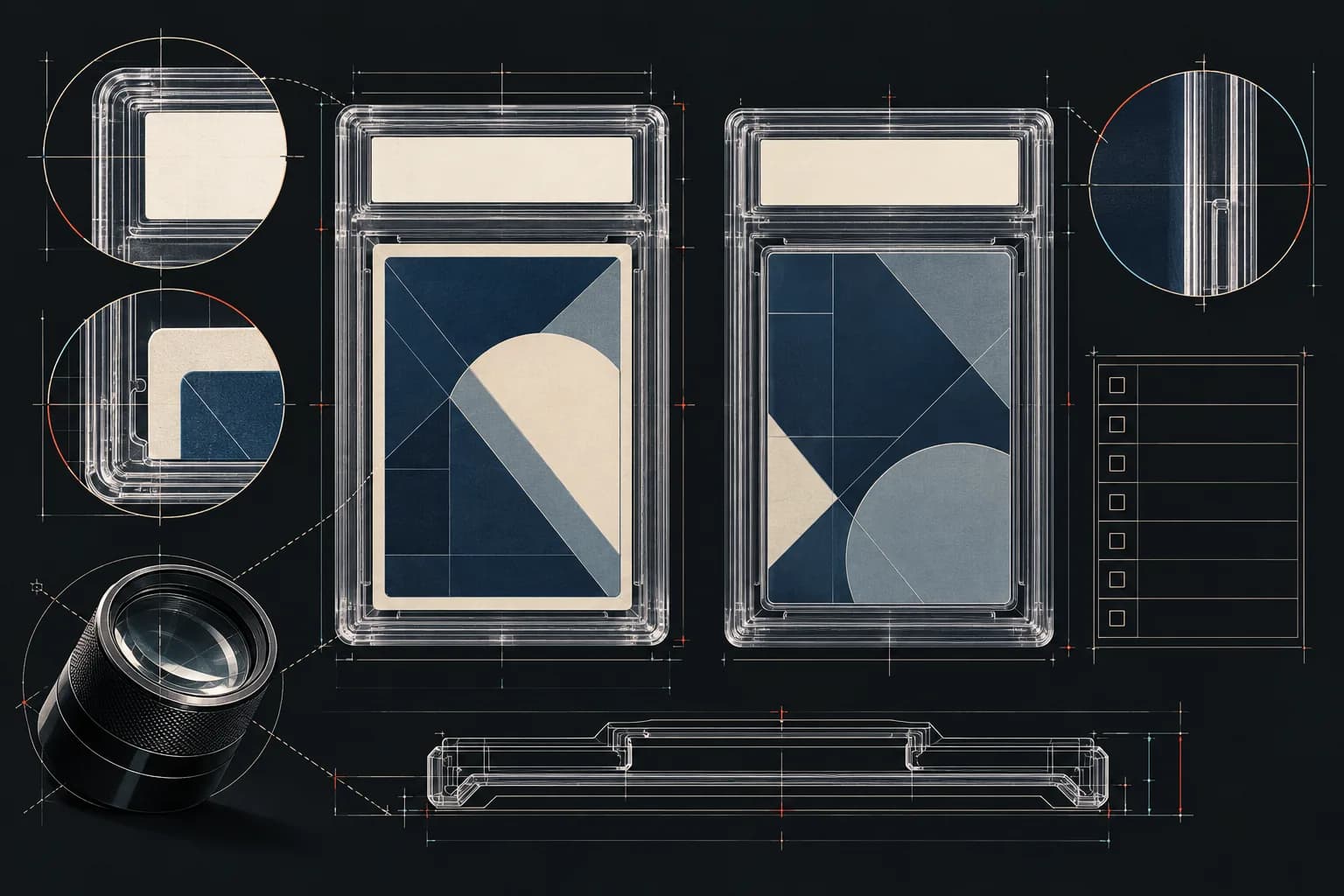
PSA sources checked October 11, 2026. The hero is original editorial artwork showing generic holders, rather than an official PSA slab or authentication example.
Start with a readable label and your own lookup
Ask for clear photographs of the complete front and back of the slab, including the label. Copy the certification number from those photographs and enter it yourself at PSA Cert Verification.
Keep the listing and result open side by side. Save the listing URL, cert number and date of your check in your collecting notes. A seller's screenshot should be a prompt for your own lookup.
For a mobile lookup, PSA's FAQ describes two app methods: scanning the label or QR code through Scan a Card, or entering the Cert ID through Text Search. Either way, read the returned details before moving on.
Compare the record, label and actual card
Use this as a comparison worksheet. Check each detail wherever it appears; mark anything missing as an unanswered question.
| Detail | What to compare |
|---|---|
| Certification number | The photographed label and your independent lookup |
| Year and set | The listing title, label and record |
| Player and card number | The card itself, label and record |
| Version | Any listed parallel, variation or other designation |
| Grade | The complete label wording and record, including any qualifier |
| Physical appearance | Front and back photos, plus PSA images when available |
Do not treat an unexplained mismatch as a harmless typo. Request clarification or contact PSA before buying.
For a football want list, our Heritage Football rookie checklist guide separates base card numbers from autograph codes. Establish that identity first, then add the grading company and full label details to your search.
Use PSA scans when the record provides them
PSA describes SecureScan in its FAQ: it takes front and back images of encapsulated items and makes them available through certification verification. PSA also says it does not accept customer-supplied images for that service; the item must be imaged in-house.
When images are available, compare the card's borders, image placement and visible marks with the seller's photographs. Ask for closer views if lighting or resolution prevents a useful comparison.
If your lookup supplies no images, leave that comparison unfinished and request better seller photos. Do not turn the absence of a scan into a verdict about authenticity.
Check the holder as well as the number
PSA's security guide illustrates its LightHouse label features and describes its holder as tamper-evident. Its FAQ explains that tamper-evident means an attempt to compromise the holder leaves evidence.
Request close photographs of the label area, holder edges and seams. If something looks damaged or inconsistent, ask PSA for guidance instead of trying to settle the issue from one photograph. Treat these as screening steps, rather than a home authentication service.
What does a valid PSA cert number prove?
It confirms database information associated with that number. PSA's verification notice says the company does not inspect online listings or guarantee that an item offered under a valid number is a genuine PSA-authenticated item.
Our practical takeaway is to combine the lookup with actual-item photographs and seller research. A matching record should not replace those checks.
What if the number does not return a result?
Recheck every digit against a clear label photograph and try the official lookup again. If it still fails, contact PSA through the support link in its FAQ. Hold off on buying while the certification question remains unresolved.
Avoid declaring a card genuine or counterfeit from a failed search alone. Record what you could verify and what still needs an answer.
Compare listings after completing the checks
For each candidate, save the exact card identity, full grade, cert number, photo comparison and seller terms. Then compare matching sales using our price research guide. If you are deciding whether to submit a raw card yourself, continue to is your card worth grading?.
The disclosed eBay searches below cover PSA-graded singles across several product families and years. Refine them with your target year, player, number, version and grade. A search result does not verify the listing's certification or availability. Visit our shop to browse the linked store's current inventory.
Next step: choose one candidate listing, perform your own PSA lookup and complete the comparison worksheet before buying. Return to the collecting guides hub for the next step in identification, condition or price research.
Explore cards and compare listings
Affiliate disclosure: As an eBay Partner Network participant, we may earn a commission from qualifying purchases through these links.
These searches cover the wider eBay marketplace. Check the year, format, condition, seller, and shipping date in each listing; search results are not verified inventory or guaranteed availability.
- Compare PSA-graded Heritage Football singles on eBay
- Compare PSA-graded Chrome Football rookies on eBay
- Compare PSA-graded Bowman Chrome Baseball rookies on eBay
Browse TheCardBoardReport’s own eBay store — current inventory may include other products.