2025-26 Upper Deck Tableau Hockey Box Contents Guide
See what Upper Deck puts in a 2025-26 Tableau Hockey box, which checklist ratios fit that list, and where the Dark Ice print-run line still conflicts.
- Published
- Updated
- Read
- 9 min
Upper Deck has published a 27-card box breakdown and a full checklist for 2025-26 Tableau Hockey. The product page does not print a street date. GTS Distribution, Upper Deck's distributor, posted on October 29, 2026 that the release is scheduled for Wednesday, November 11, 2026. Treat that as the distributor date until Upper Deck prints one on its own page.
The useful part is the box list. Most of it is an average, not a guarantee. A few lines use "at least" or "minimum," and those words should stay attached to the lines that use them.
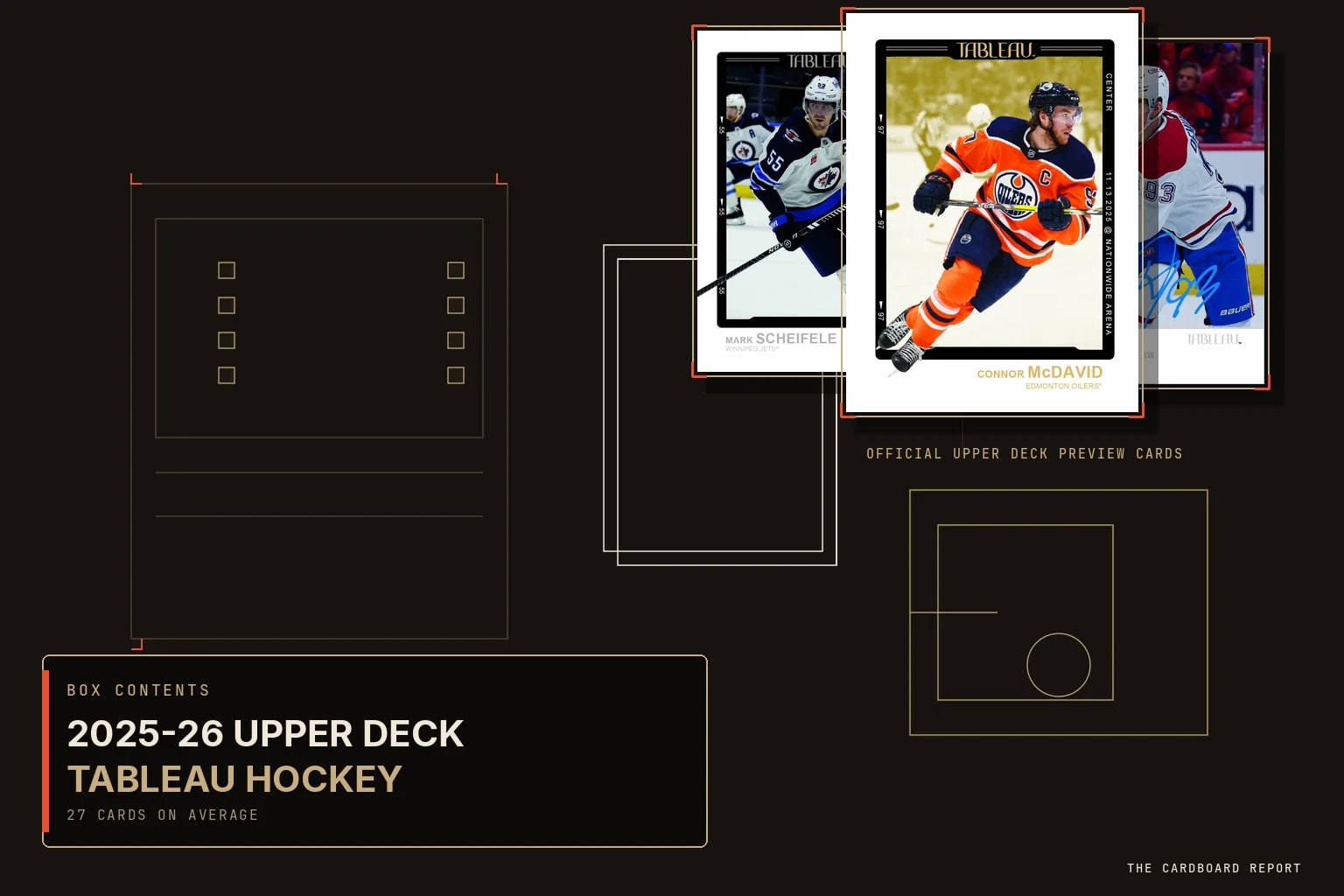
Upper Deck's product page, checklist and hockey checklist archive, plus the GTS Distribution post, were checked November 9, 2026, about 7:15 a.m. Central. Card images in the hero are official Upper Deck preview cards — Mark Scheifele Base Set Veterans, Connor McDavid Base Set Stars Gold Monochrome and Ivan Demidov Autograph — from the Tableau product page, shown for identification. They are not store inventory. The blueprint background and title panel are original CardBoard Report artwork.
What Upper Deck says is in the box
The Tableau product page heads the breakdown "Box Hits (On Average)" and says each box has 27 cards. The slots below add to 27. That sum is a check of the list, not a second source.
| Stated slot | Count in the average |
|---|---|
| Numbered base parallels and/or numbered Shadow Portraits parallels | 5 |
| Numbered Base Set Veterans | 4 |
| Numbered Base Set Stars and/or Rookie Watch | 4 |
| Encased hard-signed autographs | 2 |
| Babineau Collection | 2 |
| Shadow Portraits | 2 |
| Aspects, Dark Room, Imprints and/or Triple Exposure | 2 |
| Lenticular variants | 2 |
| Encased numbered card: Plexi, Babineau variant, Lenticular Monochrome, or Dark Ice Rookie | 1 |
| Numbered Mounted Slide Relic | 1 |
| Numbered Matted Border variation or True Monochrome parallel | 1 |
| Matted Silver Border | 1 |
| Total | 27 |
Read the "and/or" rows as one shared slot. Four Stars and/or Rookie Watch cards is not four of each. Two cards from Aspects, Dark Room, Imprints and/or Triple Exposure is not two of each set. The encased numbered slot is one card from a list of four possibilities, so a Dark Ice Rookie base card is not promised in every box.
Two sentences are stronger than the average. Upper Deck says at least 16 of the 27 cards are numbered, and at least eight are numbered to 199 or less. On autographs, the page says each box contains one encased Autograph-set card, "1 of the minimum 2 autograph cards in each box." The minimum of two matches the average line of two encased hard-signed autographs. The second autograph is not assigned to one subset. Dual Autographs, Shadow Portraits autos and Shutter Speed Signatures are all encased autograph families on the checklist. Pulling one of them is not the same event as pulling the base Autograph card.
The checklist agrees on the set sizes
Upper Deck's Tableau checklist is linked from the hockey archive under an October 28, 2026 heading. Counted from that page, the base groups match the product page:
| Checklist group | Cards | Numbers | Numbered to | Odds text on those rows |
|---|---|---|---|---|
| Base Set veterans | 100 | 1–100 | 999 | Random inserts in packs |
| Base Set Stars | 50 | 101–150 | 999 | Random inserts in packs |
| Dark Ice Rookies | 30 | 151–180 | 100 | Random inserts in boxes |
| Rookie Watch | 50 | R-1–R-50 | 999 | Random inserts in packs |
Veterans and Stars are 40-pt on both the product page and the checklist's point column. Dark Ice Rookies are encased, 40-pt, and marked Rookie. The product page also says Veterans and Stars carry the date and location of the photo, including the venue. That is an identification detail, not a parallel.
The product page's veteran and star parallel ladder runs from a Monochrome numbered to 199 down to a True Gold Monochrome 1-of-1, with Grayscale, Blue and Gold versions of both a background-only monochrome and a full-image true monochrome. The checklist prints that ladder as /199, /99, /50, /25, /10 and /1 for both the 100-card veteran group and the 50-card Stars group. Those are serial limits for a parallel of one card. They are not the odds of pulling the parallel.
One print run does not match
Dark Ice is the conflict. The product page says to chase Dark Ice True Blue Monochrome numbered to 10, and True Gold Monochrome numbered 1-of-1. The checklist's True Gold Dark Ice rows are numbered 1. Its True Blue Dark Ice rows, including Axel Sandin-Pellikka at card 151, are numbered 25.
Both pages are Upper Deck's. They were both live on November 9. Until Upper Deck reconciles them, the True Blue Dark Ice print run is unresolved. Do not pay a "/10" price for a card whose checklist row says 25, and do not ignore a printed /10 on the card itself. The number on the card is the copy you are holding. The conflict is about which document describes the product.
Other serial limits on the checklist also vary inside a single parallel name. Autographs True Blue Monochrome rows use 10, 35 and 99. Shutter Speed Signatures use 25, 99 and 199. A parallel name is not one print run when the #'d column changes by card. Read the stamp, then the row.
Checklist ratios, and the pack count Upper Deck does not print
Some checklist rows replace "random inserts" with a ratio, printed twice: "1:16 h, 1:16 e" and similar. The checklist page does not define "h" or "e". The product page does not say how many packs are in a box. Without those two facts, a 1:X ratio cannot be turned into a verified per-box expectation. Expected count per box would be packs per box divided by X, and only after the ratio is known to be per pack.
This is the test we ran anyway, labeled as a model. Assume "h" means hobby packs, assume the ratio is the rate for any card from that set, and assume 8 hobby packs per box. Then expected count = 8 / X.
| Set, ratio printed on each of its rows | Model at 8 packs | Product-page average |
|---|---|---|
| Autographs, 1:8 | 1.00 | 1 Autograph-set card |
| Babineau Collection, 1:4 | 2.00 | 2 |
| Shadow Portraits, 1:4 | 2.00 | 2 |
| Aspects, Dark Room, Imprints, Triple Exposure, each 1:16 | 0.50 each, 2.00 combined | 2 from those four sets |
| Lenticular and Lenticular Rookie Watch, each 1:4 | 2.00 if you count the ratio once, 4.00 if you add both rows | 2 lenticular variants |
| Matted Silver Border and its Rookie Watch version, each 1:8 | 1.00 if you count it once, 2.00 if you add both rows | 1 Matted Silver Border card |
The first four lines land on the product page. The last two land only if the veteran row and the Rookie Watch row are the same rate printed twice. Adding them overshoots the box list. That is evidence against treating every repeated ratio as a separate event. It is not evidence that Upper Deck has said the box contains 8 packs.
Because the pack count is inferred, this guide does not publish boxes-per-card figures from the ratios. The dual-autograph rows are printed 1:1,200. Under the 8-pack model that would be a very small per-box count, but the model is not a printed configuration, so the number stays in the audit notes. Do not use it to decide what a box is "worth."
These model figures are expected counts under stated assumptions. They are not the probability of at least one hit. They are not independent of collation. Upper Deck's own box list already says several slots are "and/or," which means the subsets share a slot instead of landing as separate coin flips. No "at least one" probability is offered here.
"Random inserts in packs" and "random inserts in boxes" are also not 1:X odds. Base veterans say random inserts in packs. Dark Ice base cards say random inserts in boxes. That difference matches the box list, where veterans have their own four-card slot and a Dark Ice base card is only one option in a single encased slot. It still does not tell you the chance of a specific player.
What the checklist cannot price
A 100-card veteran set numbered to 999 is a lot of different cards. The family odds, once someone treats them as family odds, are not the odds of one player. We did not assume every player is seeded equally, and the checklist does not say that they are.
The same caution applies to the 76-card Autograph list. Twenty-seven of those rows are marked Rookie. All 76 Autograph rows print 1:8 h, 1:8 e, including Alex DeBrincat and rookie Artyom Levshunov. That is the set rate repeated on the rows. It is not a per-player rate, and it is not a guarantee beyond the product page's minimum of two encased hard-signed autographs.
Thickness is real on this product and worth checking before you order a holder. The product page states 40-pt for Veterans and Stars, 42-pt for Matted Border cards and 60-pt for Mounted Slide Relics. The checklist's point column also prints 42.5 on Lenticular rows. Measure the card you have. The point and holder guide covers how. Encased cards are not the same object as graded slabs. The encased versus graded guide separates the two.
Buyer checks
- Confirm 2025-26 Upper Deck Tableau, not Stature, Ice, Premier or another Upper Deck hockey set from the same season.
- Use November 11 only as GTS Distribution's date. The Upper Deck product page did not print a street date at this check.
- Expect the average box list, and treat only the "at least" and "minimum" sentences as minimums.
- Do not pay a Dark Ice True Blue premium that depends on /10 versus /25 until the card's own stamp and a reconciled Upper Deck document agree.
- Keep dual autographs, Shutter Speed Signatures and the base Autograph set as different checklist lines.
- For a presale or a "release week" shop listing, read the presale guide and compare delivered cost with the price research guide.
- For raw singles, match the card number on the checklist and inspect condition with the raw card guide.
A November 9 look at TheCardBoardReport's eBay store did not show a Tableau Hockey listing on the public store page. Use the store link to browse live inventory. It is not a claim that a Tableau card is in stock.
There is no verified U.S. retail price on the Upper Deck page we read, so this guide has no cost-per-card math and no recommendation that depends on a box price. If you want one rookie or one autograph, the single is the direct purchase. If you want the stated mix of thick base cards, encased autographs and numbered inserts, the box is the product Upper Deck described. It is not a payout.
Next reading: the November 4–11 release hub for the rest of this window, the November 13–18 hub for the following Topps releases, and the new-releases hub. The serial-number guide is the right companion when a parallel uses more than one print run.
Method and sources
Method: Box slots were added and checked against the stated 27 cards. Checklist group sizes and the 1:X strings were taken from the live checklist table. The 8-pack column is a labeled model, not a printed configuration. Ten checklist rows were re-read individually and recorded in the audit notes. No at-least-one probability was calculated.
- Upper Deck: 2025-26 Tableau Hockey product page. The hero uses three preview cards from that page, for identification only.
- Upper Deck: 2025-26 Tableau checklist
- Upper Deck: hockey checklist archive, which lists the Tableau checklist under October 28, 2026
- GTS Distribution, October 29, 2026: Tableau product post with the November 11 date
Affiliate disclosure: Some links on The CardBoard Report may earn us a commission. See our disclosure.
Explore cards and compare listings
Affiliate disclosure: As an eBay Partner Network participant, we may earn a commission from qualifying purchases through these links.
These searches cover the wider eBay marketplace. Check the year, format, condition, seller, and shipping date in each listing; search results are not verified inventory or guaranteed availability.
- Research 2025-26 Upper Deck Tableau Hockey boxes on eBay
- Research 2025-26 Tableau Hockey autographs on eBay
- Research Tableau Hockey Dark Ice rookies on eBay
Browse TheCardBoardReport’s own eBay store — current inventory may include other products.